Hangul Unread
Hangul as a Designed System
For over a decade, my work has treated the Korean alphabet not as language but as designed structure. The inquiry began by hand, reinterpreting Hangul through vector and pattern, and deepened in generative code, where a small set of letters organizes itself by rule into endless combinations. The more closely I studied that system, the more its elegance asked to be shared. Across each iteration, the central question remains the same: what happens when a writing system is experienced as form rather than read as language?
Generative behavior of Hangul consonants
Year
2026
Medium
p5.js, JavaScript, Generative Animation
Related Recognition
SEE KOREA: Beyond What You Read
Winner, 63rd American Inhouse Design Awards, GDUSA
Poster developed from the Hangul Unread research
Related Work
SEE KOREA: Beyond What You Read
Poster series, 2026
Process and AI-Assisted Development
The generative system was developed through an iterative, artist-directed process. Generative AI was used to support p5.js coding, debugging, and technical prototyping. The conceptual framework, Hangul classification system, behavioral rules, parameter decisions, visual direction, and final outcomes were conceived, tested, and directed by Samantha Yoo.
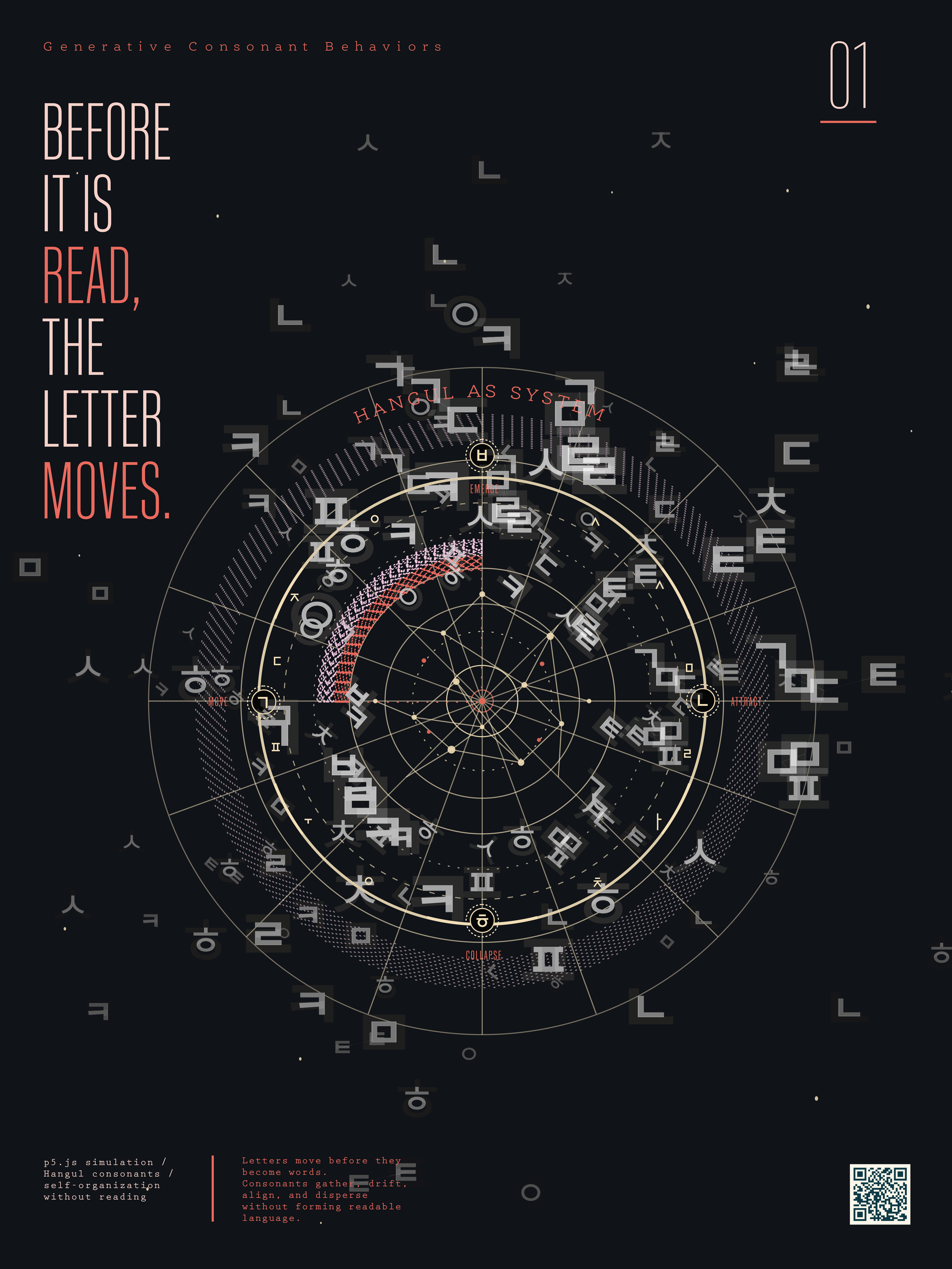
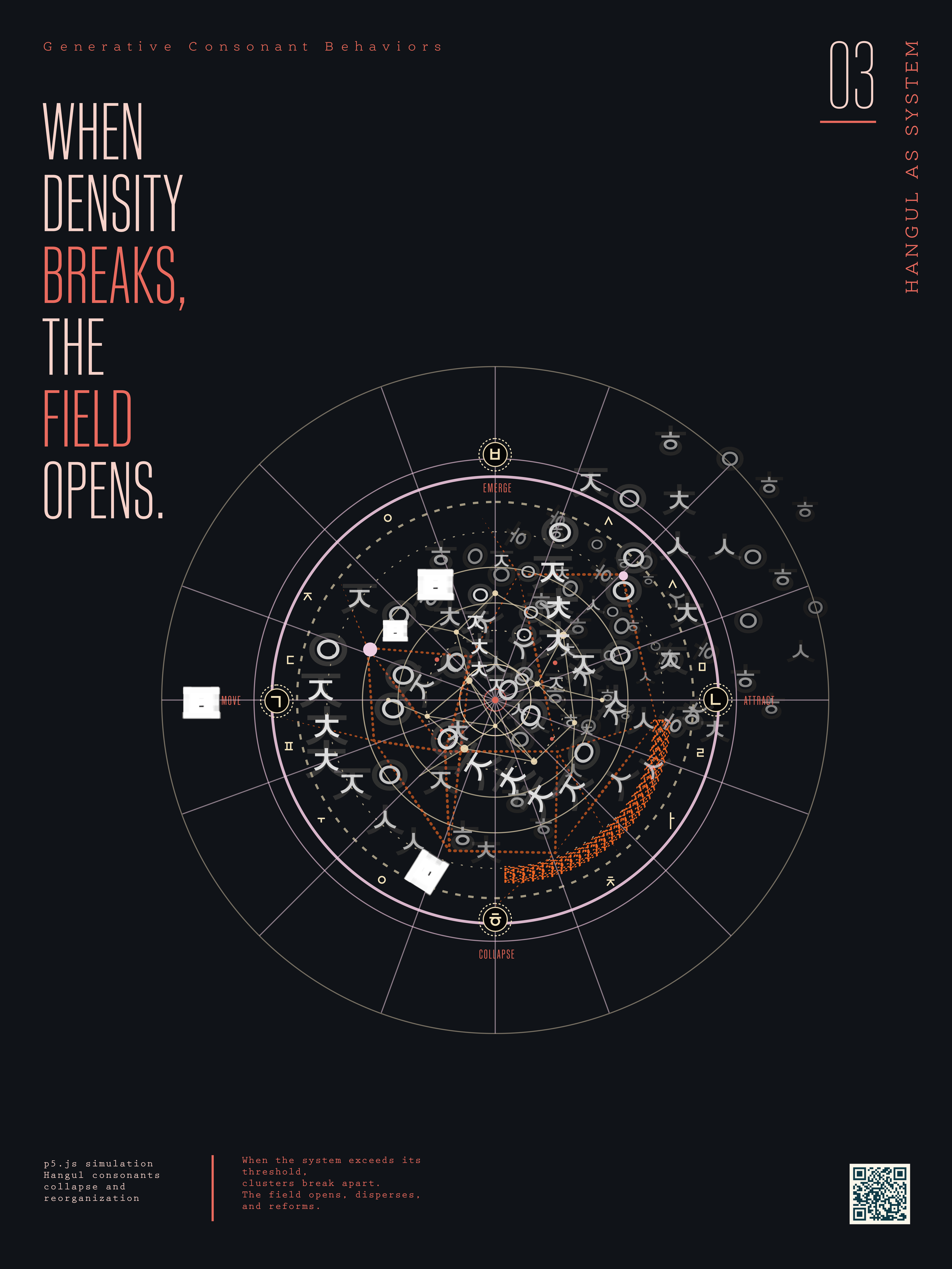
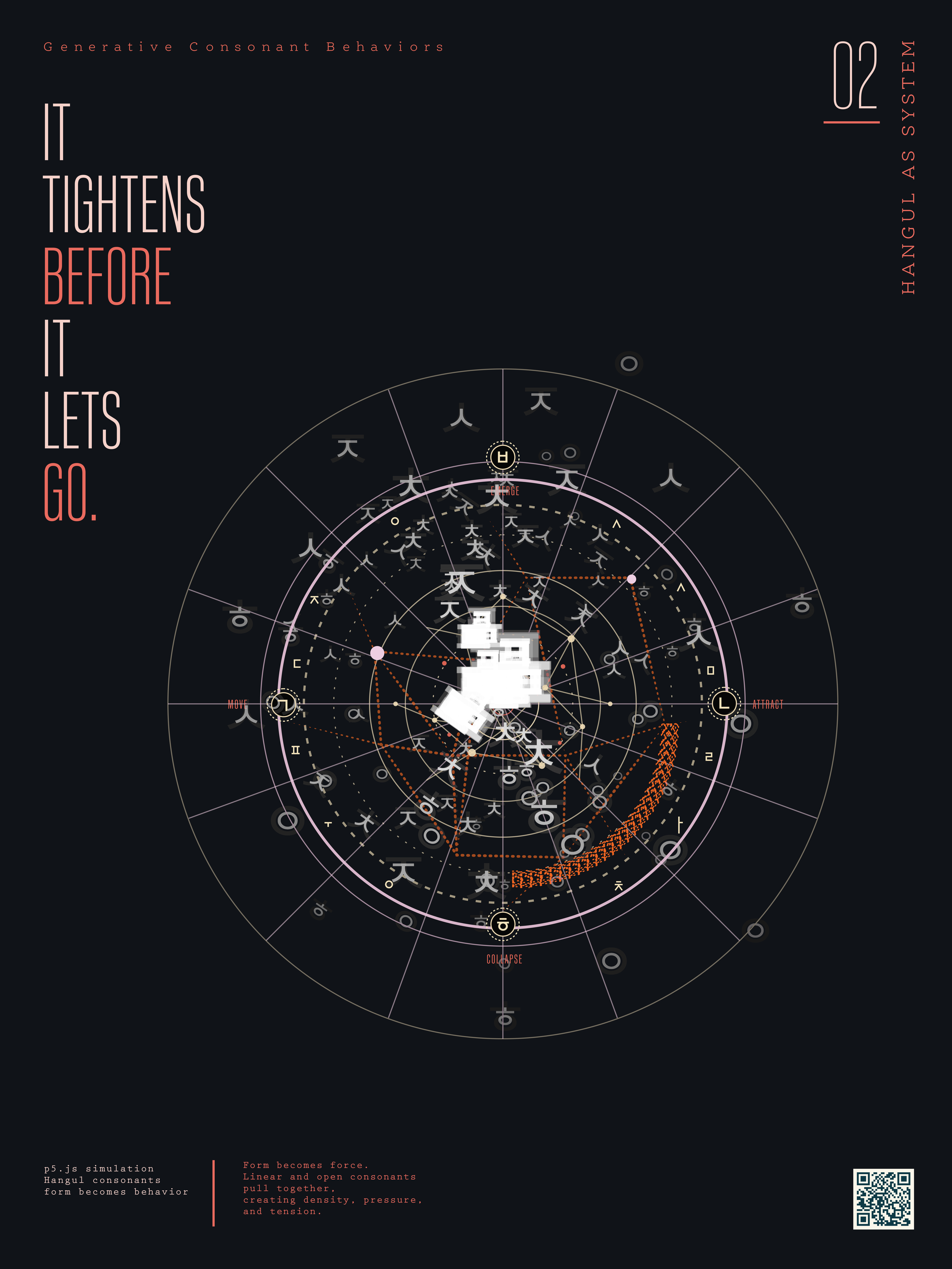
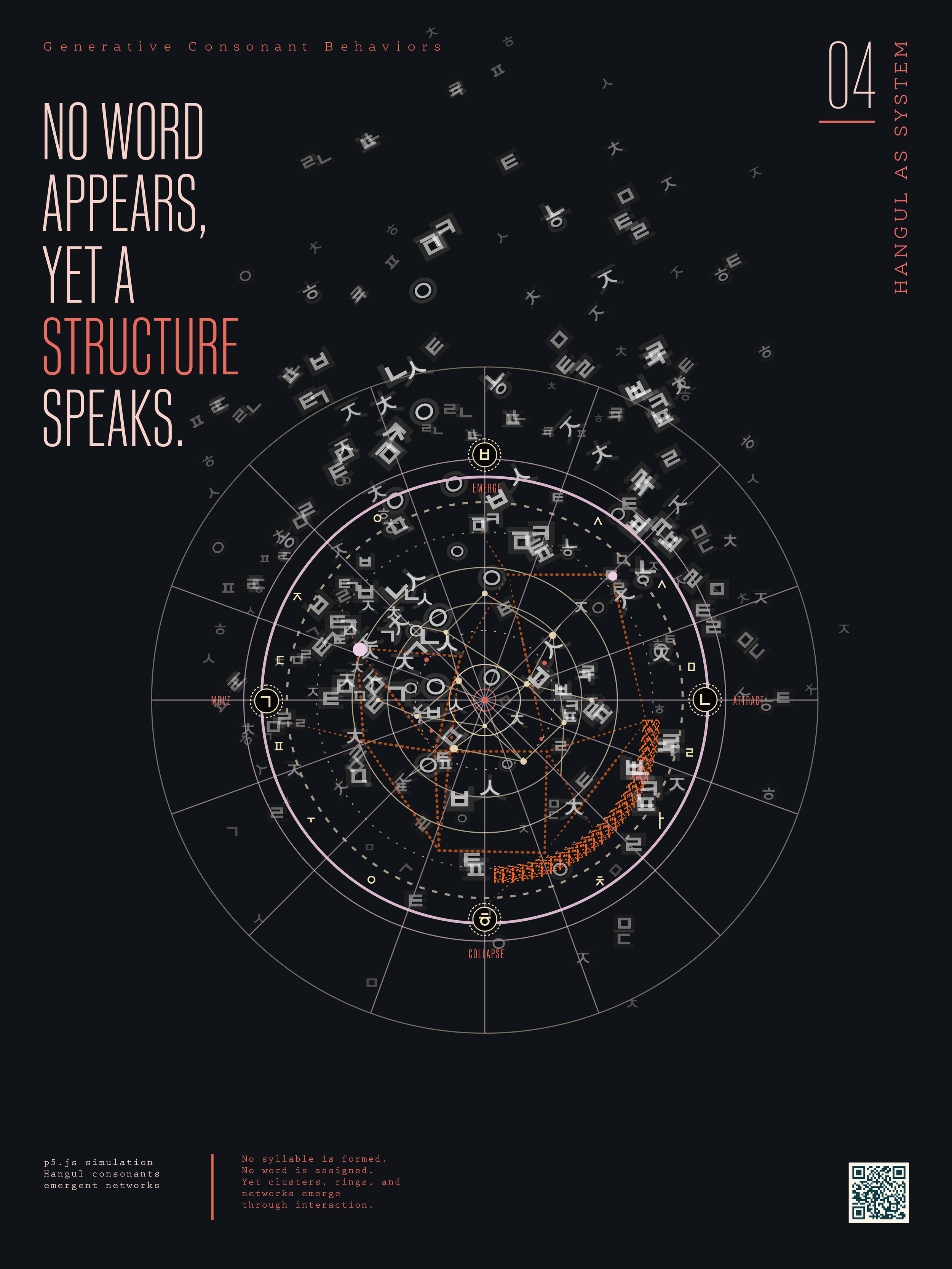
Hangul Unread is a generative system in which the consonantal forms of the Korean alphabet drift and reorganize according to proximity, producing spatial configurations that never quite resolve into readable text.
Built in p5.js, the work treats each consonant not as a fixed glyph but as an autonomous element governed by simple rules of attraction and repulsion. The forms are drawn from the design logic of the Hunminjeongeum (1446), in which consonants were modeled on the shape of the speech organs and set within a square field, the nemo-teul, that binds individual letters into modular syllabic blocks. Here that modular field is released. The blocks come apart, and the consonants are left to find their own arrangements.
The project takes its theoretical footing from Philip Galanter's account of generative art and complexity, which locates the most compelling generative work in the space between rigid order and pure randomness. The Hunminjeongeum is a productive case for this reading, because it is already a rule-based, featural system: a script that was designed, not inherited. To reinterpret it computationally is less to impose an external framework than to make visible a generative logic that was latent in its original design.
What the title names is the condition the work produces: a writing system encountered as spatial structure rather than as language. Stripped of legibility, Hangul appears as what it also always was: a generative visual system, a small set of forms capable of producing endless configuration. This reframing carries particular weight in a moment of automated text generation. Against the flattening of writing into machine-produced content, the piece insists on the letter as a constructed object, and on the structural intelligence that produced it.
Hangul Unread runs live at samanthayoo.com and serves as the generative engine behind SEE KOREA: Beyond What You Read, a promotional poster recognized as a Winner at the 63rd American INHOUSE Design Awards (GDUSA, 2026).